
Personal Car Trainer vs Driving School in Chennai: Which Is Better?
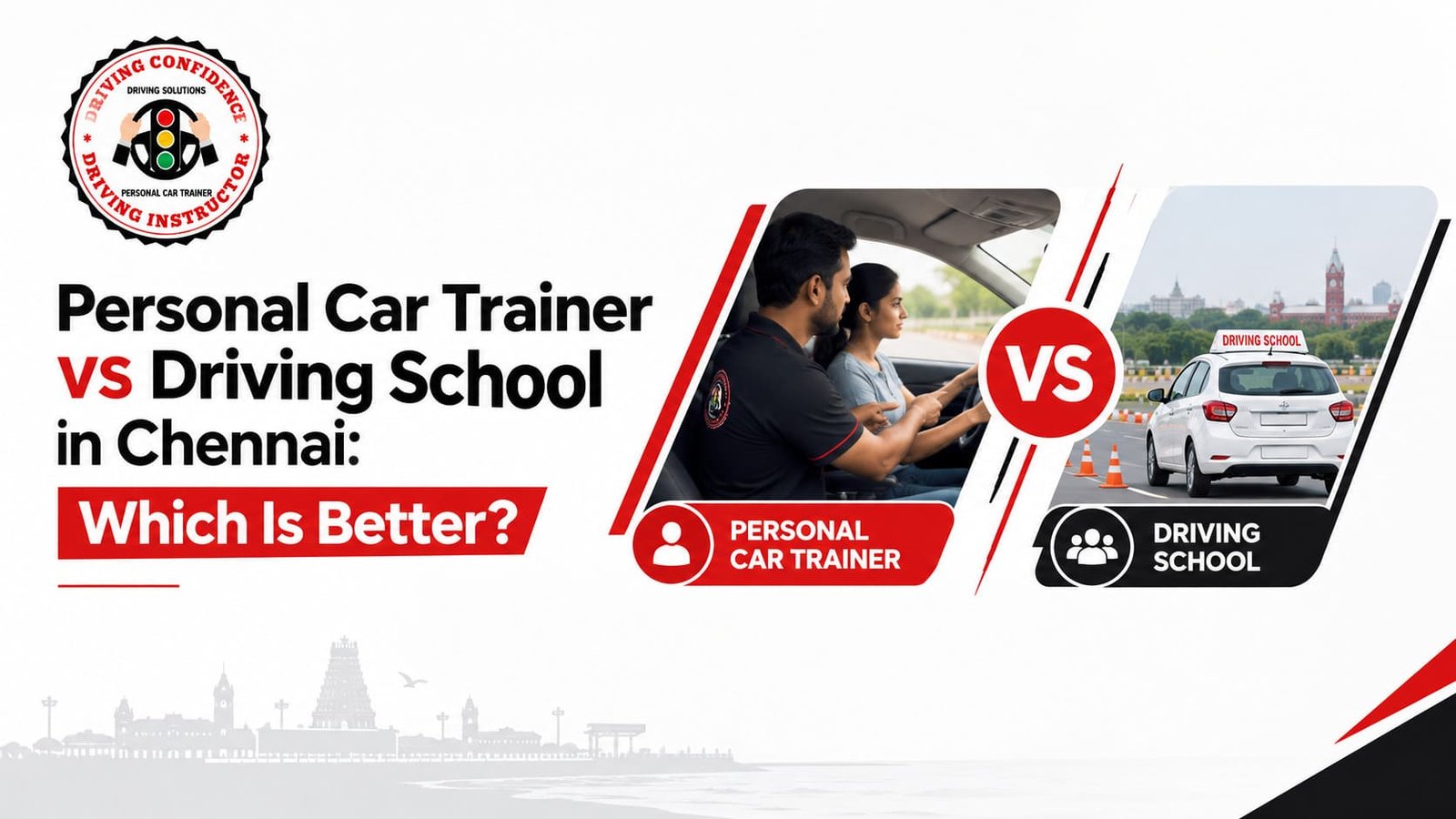
If you’re learning to drive in Chennai, you’ve probably run into this exact question while comparing options: should you join a driving school, or hire a personal car trainer? Both can get you a licence. But they don’t get you there the same way, and for many learners, the difference matters more after the licence than before it.
This guide compares the two options honestly, based on how each one actually works, so you can pick the one that fits how you learn, the car you’ll drive, and the amount of time you have.
Quick Answer
A driving school typically trains small groups in a shared training vehicle on a fixed batch schedule, which works well for learners who want a structured, budget-conscious course and don’t mind sharing instructor time. A personal car trainer provides one-to-one instruction, often in the learner’s own car and on a schedule built around the learner, which tends to suit people who get nervous in traffic, want to train in the car they’ll actually drive daily, or didn’t build real confidence after a previous driving school course. Neither option guarantees a driving test pass or a fixed number of training days — that depends on individual practice, the RTO test, and each learner’s pace.
Key Takeaways
- A driving school usually means shared instructor attention, a training vehicle you won’t drive again, and a fixed class timetable.
- A personal car trainer usually means one-to-one attention, training in your own car, and a schedule set around your availability.
- Vehicle familiarity matters: learning the clutch, mirrors, and dimensions of the car you’ll actually drive builds muscle memory faster than switching cars after your licence.
- Nervous or previously unsuccessful learners generally benefit more from one-to-one pacing than from a shared batch environment.
- Cost, area coverage, and instructor language are practical filters — always confirm these directly rather than assuming.
- A Learner’s Licence (LLR) from your local RTO is required before you can legally practise driving on public roads, regardless of which training option you choose.
- Neither a driving school nor a personal trainer can guarantee you will pass your RTO driving test — that decision rests with the RTO.
What Is a Driving School?
A driving school is a structured training centre that teaches multiple learners, usually in batches, using the school’s own training vehicles. Learners typically travel to a fixed pickup point or the school’s office, and instructor time is shared across the group during each session.
Driving schools in Chennai range from independent neighbourhood operators to dealership-run training centres. Most follow a set number of days (commonly a few weeks) and a semi-fixed daily route, with the instructor also assisting learners with paperwork for the Learner’s Licence in some cases.
What Is a Personal Car Trainer?
A personal car trainer is one-to-one driving instruction, where a single trainer works with one learner at a time — often in the learner’s own car rather than a separate training vehicle. Because there’s no group to manage, the pace, route, and focus areas can be adjusted to the individual learner from lesson to lesson.
DCDI Driving Solutions is a personal car trainer service based in Chennai that follows this model: one-on-one, doorstep lessons, in the student’s own car. According to the About DCDI page, the service was built specifically in response to the pattern of learners finishing a driving school course with a licence but without real confidence in traffic — a gap that shared instructor time and unfamiliar training vehicles can leave behind.
Personal Car Trainer vs Driving School: Side-by-Side Comparison
| Factor | Driving School | Personal Car Trainer |
|---|---|---|
| Instructor attention | Shared across a batch of learners | One-to-one, full session focus |
| Training vehicle | School’s own training car | Usually the learner’s own car |
| Schedule | Fixed batch timing | Built around the learner’s availability |
| Location | Often travel to the school or a fixed pickup point | Doorstep, on roads in the learner’s own area |
| Pacing | Standard syllabus pace for the group | Adjusted to individual learning speed |
| Best suited for | Learners comfortable in a group setting, tighter budgets, straightforward beginners | Nervous learners, own-car training, working professionals with limited fixed hours, learners who need focused practice on specific skills |
| Typical focus | General syllabus covering basics to licence readiness | Can be structured (e.g., staged programs) or customised to gaps like parking, highway driving, or traffic confidence |
Why the “Own Car vs Training Car” Difference Matters
This is one of the most underrated differences between the two options, and it’s worth understanding properly.
When you learn in a school’s training car, you’re building muscle memory for that specific vehicle — its clutch bite point, mirror angles, and exact dimensions. The moment you start driving your own car after getting your licence, a lot of that adjustment has to happen all over again, usually without an instructor present.
Training in your own car from day one means the clutch, brakes, mirrors, and blind spots you practise with are the same ones you’ll use every day afterward. This is a core part of how DCDI structures its lessons — as explained on the DCDI homepage, lessons run in the learner’s own car so that muscle memory transfers directly to daily driving instead of needing to be rebuilt after the course ends.
If you don’t yet own a car, this point doesn’t apply, and a driving school’s training vehicle is a reasonable way to learn the fundamentals.
Common Mistakes Learners Make When Choosing
- Choosing purely on price without asking how much individual attention you’ll actually get during each session.
- Assuming a licence means confidence. A licence confirms you passed a test; it doesn’t confirm you can handle Chennai traffic independently.
- Not asking about the training vehicle. Some learners are surprised, after finishing a course, that they still feel unfamiliar with their own car.
- Ignoring their own comfort level with groups. A learner who gets anxious being observed or corrected in front of others may do far better with one-to-one sessions.
- Not clarifying what happens if progress is slower than expected. Batch schedules are harder to extend; individual training can usually be adjusted.
Who Tends to Do Better With a Driving School
A driving school can be a sound choice if you:
- Don’t yet own a car, so training in an “own car” isn’t relevant yet
- Are comfortable learning alongside other students
- Want a fixed, predictable course length and cost
- Are a straightforward beginner with no particular nervousness about traffic or specific skills like parking
Who Tends to Do Better With a Personal Car Trainer
A personal car trainer setup, such as DCDI’s model, tends to suit learners who:
- Get nervous or anxious behind the wheel and need a calmer, patient pace
- Already own a car and want to train in it specifically
- Have an irregular or demanding schedule (working professionals, for instance) and need flexible timing rather than a fixed batch slot
- Completed a driving school course before but still don’t feel confident driving alone
- Want focused practice on a specific gap — such as parking, flyovers, or highway driving — rather than a full beginner syllabus
- Prefer a respectful, unhurried learning environment, which matters particularly for many women learners and first-time drivers
What a One-to-One, Own-Car Training Session Typically Covers
Personal car training generally moves through a progression rather than a single fixed lesson plan. As an illustrative example of how this can be structured, DCDI’s own published training programs move from basic car control through to independent driving:
- Car controls and basics — clutch, brake, accelerator coordination, seat and mirror setup
- City road driving — building comfort on quieter and then busier roads
- Traffic handling, turns, and flyovers — real-time decision-making around moving traffic
- Narrow roads, reversing, and parking — manoeuvring in tighter spaces
- Independent, confident driving — putting it all together without step-by-step prompting
Learners who want to go further can extend into heavier traffic, peak-hour conditions, and highway driving, or choose a shorter refresher focused only on the skills they’re missing — such as returning to driving after a long gap, or practising a single skill like parking.
Chennai-Specific Factors That Affect Your Choice
Chennai’s driving environment adds a few practical considerations that are worth thinking about regardless of which option you pick:
- Mixed traffic density — two-wheelers, autorickshaws, and buses often move unpredictably at junctions, which rewards traffic judgement over just vehicle control.
- Narrow residential roads — many neighbourhoods have tight lanes where parking and manoeuvring practice matters as much as open-road driving.
- Flyovers and service roads — merging and lane discipline on flyovers is a distinct skill from flat city driving.
- Rain-affected conditions — reduced visibility and slippery road sections during Chennai’s rainy months add another layer that beginners often aren’t exposed to in a short course.
Because these conditions vary by area, some learners specifically look for training that happens on the actual roads near their home, rather than a generic practice ground — which is one reason doorstep, own-area training has become a more visible option in the city.
Cost Considerations
Pricing for both driving schools and personal car trainers in Chennai varies by trainer experience, course length, area, and whether the training happens on your own car or a training vehicle. Because pricing changes and isn’t always published, it’s worth asking directly for current rates and exactly what’s included — for example, whether LLR guidance, number of sessions, and specific skills like highway or parking practice are part of the package. DCDI’s programs, listed on its homepage, note that current pricing is available on enquiry rather than published as a fixed rate, which is a reasonable practice given that course length can vary by learner.
Learner’s Licence (LLR) Requirements
Before practising driving on public roads in India, you’re legally required to hold a valid Learner’s Licence (LLR) issued by your Regional Transport Office (RTO). This applies whether you train with a driving school or a personal car trainer — training itself doesn’t replace this requirement. LLR eligibility, the application process, and test requirements are handled by the RTO through the official Parivahan Sewa portal, and the Ministry of Road Transport and Highways sets the underlying regulations. Neither a driving school nor a personal car trainer can guarantee the outcome of an RTO test — that decision is entirely the RTO’s.
Questions to Ask Before You Book
Whichever option you’re leaning toward, these questions will tell you more than a price list will:
- Will I train in my own car, or a training vehicle?
- Is this one-to-one, or will I share instructor time with others?
- Can the schedule adjust to my availability, or is it a fixed batch time?
- What specific skills are covered — city driving, parking, flyovers, highway?
- What happens if I need more sessions than planned?
- Does the trainer have experience with nervous or first-time learners?
- What languages does the instructor teach in?
- Which areas of Chennai are covered?
Frequently Asked Questions
Is a personal car trainer better than a driving school in Chennai?
It depends on the learner. A personal car trainer generally offers more individual attention and own-car training, which suits nervous learners or those who didn’t gain confidence at a driving school before. A driving school can still work well for straightforward beginners who are comfortable in a group setting and don’t yet own a car.
Can I learn driving in my own car instead of a training vehicle?
Yes. This is the core model some personal car trainers, including DCDI, are built around — learning the clutch, mirrors, and dimensions of the same car you’ll drive daily, rather than adjusting to it separately after your licence.
How many days does it take to learn car driving confidently?
This varies by learner, prior experience, and how much practice is involved. As one example, DCDI structures its core offering as a 5-Day Confidence Program for city driving, with a 10-Day Advanced Program available for learners who also want highway driving and advanced parking. Actual pacing is adjusted to the individual.
Do I need a Learner’s Licence (LLR) before starting driving lessons?
Practising on public roads in India requires a valid LLR issued by your RTO. Check current requirements on the official Parivahan portal before starting lessons.
Is personal car training available across all of Chennai?
Coverage varies by trainer. DCDI, for example, lists coverage across multiple Chennai neighbourhoods on its website, with a note to call directly if your specific area isn’t listed. Always confirm coverage for your locality directly with the trainer.
Can a beginner with zero driving experience choose a personal car trainer?
Yes. One-to-one training is not limited to refresher learners — complete beginners can start from basic car controls, just at a pace suited to them rather than a group’s average pace.
Is personal car training more expensive than a driving school?
Not necessarily, but it depends on the trainer, course length, and inclusions. Since group batch pricing and individual pricing structures differ, it’s best to ask both options for current rates and exactly what’s included before comparing costs directly.
Can I train specifically for parking or highway driving without a full beginner course?
Yes, this is typically easier to arrange with a personal car trainer through a custom or refresher-style program, since there’s no fixed group syllabus to follow. DCDI, for instance, offers a Custom/Refresher Program for single-skill practice such as parking or highway driving.
What if I already have a licence but I’m still not confident driving alone?
This is a common situation, and it’s specifically what refresher-style personal training is designed for — rebuilding confidence through structured, one-to-one practice rather than repeating a full beginner course.
How do I choose a good personal car trainer in Chennai?
Look for one-to-one attention, training in your own car, a trainer with genuine road experience and relevant certification, and scheduling that fits your availability rather than a fixed batch. Asking the questions listed earlier in this article is a practical way to compare trainers.
Making the Decision
There’s no single correct answer between a driving school and a personal car trainer — the right choice depends on your comfort with groups, whether you own a car you want to train in, how flexible your schedule needs to be, and whether you’re starting fresh or rebuilding confidence after an earlier course. If you’re still weighing the two, it can help to talk through your specific situation — your current experience, the car you’ll be driving, and the areas of Chennai you need to feel confident on — before committing to either option.
If you’d like to discuss whether one-to-one, own-car training fits your situation, you can contact DCDI or reach out directly on WhatsApp to talk through your current driving experience and the type of training that would suit you best.